Tourism chiefs in Saudi Arabia aim to attract 150 million visitors a year by 2030 — a seismic push that would catapult the once-closeted kingdom into the world’s top 10 destinations. From glittering megacities to silent desert canyons and ancient trading routes, The Citizen Traveller stepped behind the veil to sample a controversial nation undergoing breathtaking reinvention….
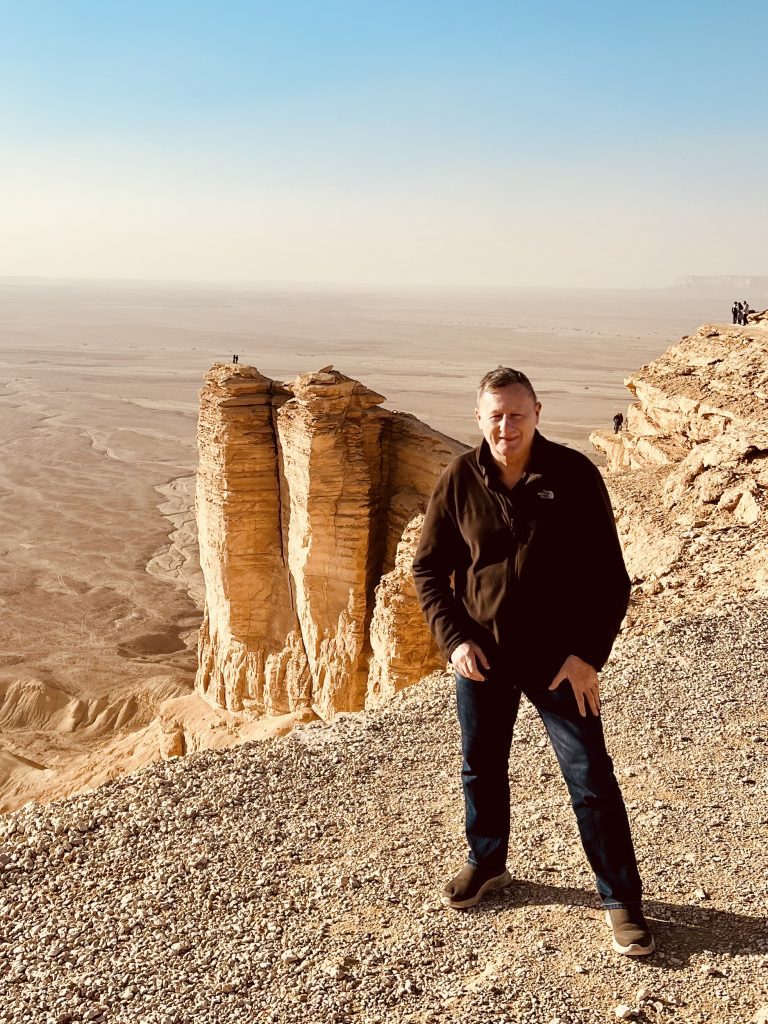
Cookson of Arabia in the desert at the ‘Edge of the World’
My journey into this newly opening land began at a place with a suitably cinematic name: the Edge of the World.
Reaching it required an hour’s taxi ride from the capital Riyadh, leaving smooth tarmac for a bone-shaking dirt road that tested both suspension and resolve. Then, quite suddenly, the land simply dropped away.
It was half an hour before sundown on a winter’s day in Saudi Arabia. Before me rose vast pillars of honey-coloured stone, sheer and silent, plunging around 300 metres into the plain below — immense, primeval forms that felt less geological than mythic.
As the light faded and a chill wind whipped across the escarpment, the scale of it became almost impossible to process. For a moment, standing at that great precipice, it felt as though time itself had thinned — and I half expected the black monolith from 2001: A Space Odyssey to materialise from the ancient rock, humming softly.
On the ride back to Riyadh, a starker Saudi Arabia emerged — one now open to foreign gaze.
We passed through working-class villages where poor women, wrapped in thin black niqabs, huddled by the roadside tending kettles on glowing charcoal burners, selling sweet tea to passing drivers. Their stalls were little more than a mat, a pot and a plume of smoke curling into the freezing desert air. Whatever riches had transformed the Riyadh skyline had clearly flowed around these roadside lives rather than through them.
The next morning I joined a small tour group and boarded a fast train north towards the UNESCO World Heritage site at Jubbah.
Riyadh’s main station — open less than a decade — felt more like a regional airport departure hall: gleaming floors, lofty ceilings and the gentle echo of rolling suitcases. The trains, French-Italian built, were modern, smooth-riding and comfortably plush.
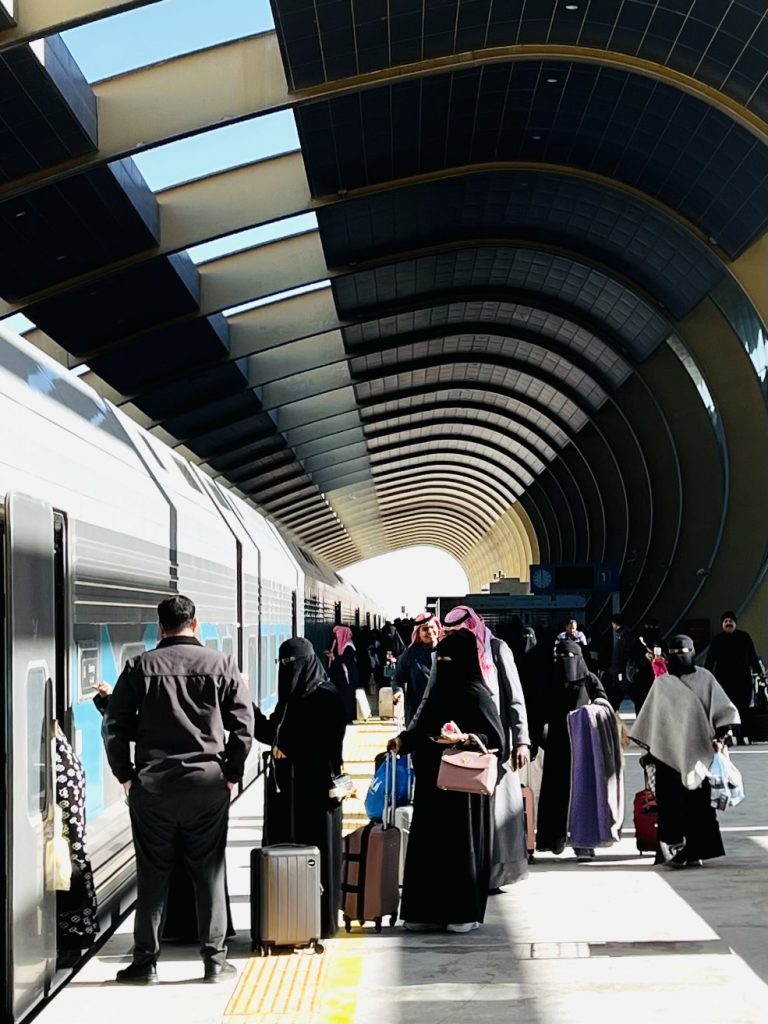
Fast train from Riyadh
Seats were allocated, but local norms required a courteous ballet of rearrangement. Men politely swapped places to avoid sitting directly beside unfamiliar women; facing each other across a table, however, was perfectly acceptable.
An hour into the journey, the sheer scale of this desert kingdom revealed itself. Charging along at 100 mph, the train kicked up a pale plume of dust — a contrail on land. Through the wide windows there was mostly emptiness. Occasionally, feral camels prowled the scrub, or a sudden flash of green signalled a hidden oasis fringed with trembling bulrushes. But otherwise, life was scarce.
Twice we stopped at immaculate, modern stations where no one seemed to get on or off. Their clocks were frozen stubbornly at midday — as if time itself had decided to take a rest.
From that stillness, the train pressed on, deeper into a country that remains intriguing, vast and only partly revealed.
We reached Jubbah, a settlement cradled by dramatic sandstone outcrops rising from the desert like stranded ships. Their rust-red surfaces form a vast open-air gallery: petroglyphs and inscriptions dating back around 7,000 years. The rocks teem with ancient images — hunters in curious headgear, elegant gazelles mid-leap, mischievous monkeys.
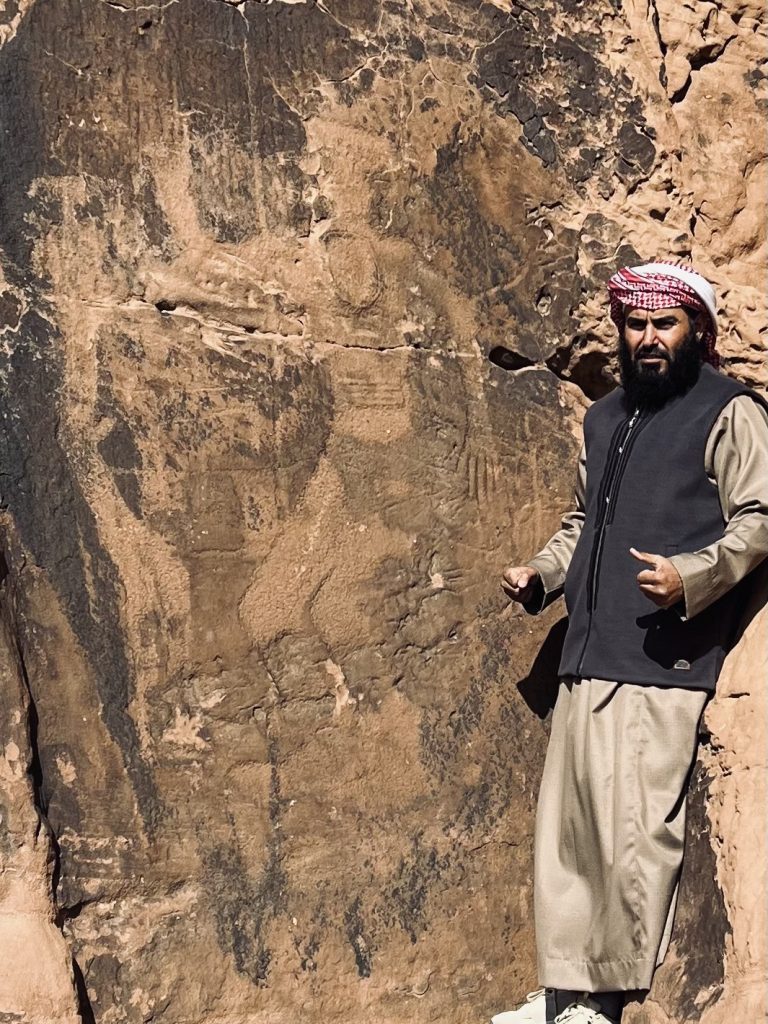
A guide shows 7,000 year old etchings at Jubbah
You don’t merely look at these figures — you feel observed by them. As the desert wind hissed through the canyons, I sensed the presence of the artists themselves: people who once stood here recording their world in stone.
One carving in particular halted us. High on a slab of sandstone was a startling scene: a local king greeting a male subject depicted with an unmistakably erect penis. Our guide — usually encyclopaedic on dates and dynasties — suddenly turned bashful. Pressed for context, he offered only a giggle before ushering us toward safer ground: antelopes, monkeys and hunters with bows. The meaning of that intimate greeting has clearly been lost to time.
Another 400 miles by coach took us across landscapes shifting from pale dunes to dark volcanic fields before the road delivered us to AlUla — once a thriving Nabataean outpost, now Saudi Arabia’s crown jewel of heritage tourism. Here the desert rears into cliffs of burnished sandstone, riddled with canyons, tombs and rock-hewn sanctuaries that rival Petra in scale and mystery.
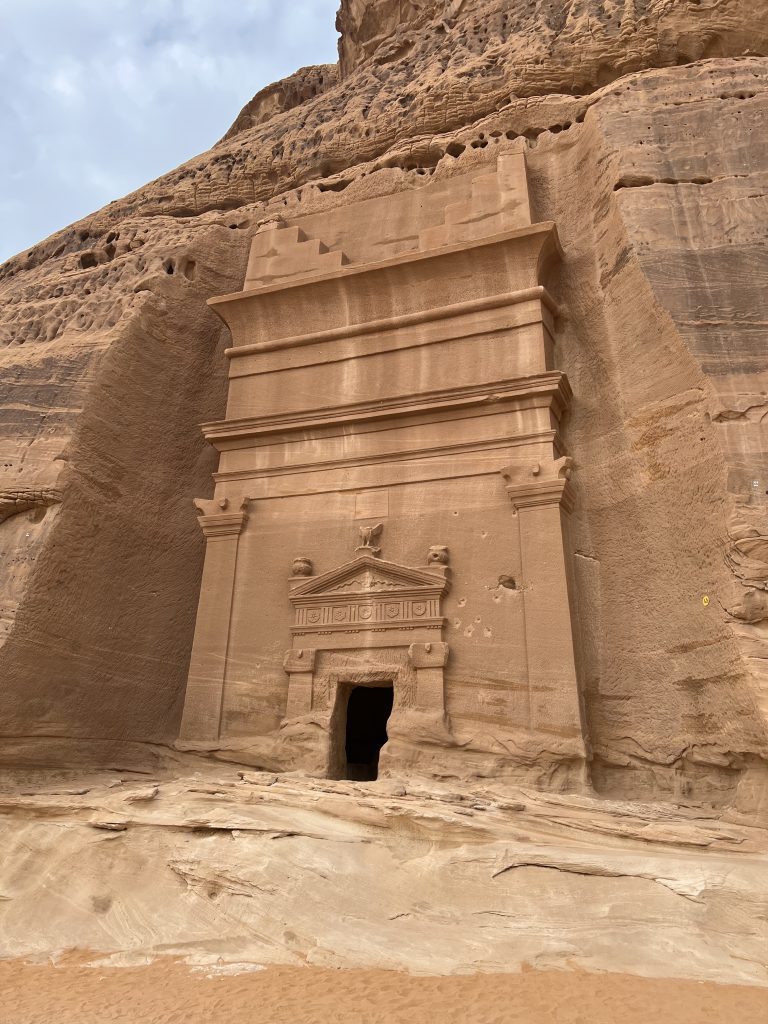
Nabataean burial chamber at AlUla
AlUla is still very much a work in progress. Not long ago, archaeologists uncovered a human skeleton in one of the rock-cut graves. Using AI, they reconstructed her face, resurrecting a woman from antiquity with startling immediacy. And there she was in the exhibition centre: poised, enigmatic, her expression recalling the Mona Lisa. Those eyes — steady, knowing — seemed to gaze straight through time. Simply stunning.
On the fifth day we reached Medina, the city of the Prophet Mohammed and the site of his tomb. I had imagined a dusty old town softened by history — but Medina pulsed with modern life and devotion.
At every sacred site, thousands upon thousands of pilgrims pressed into vast mosque complexes, moving like a human tide. They’d come from Indonesia and Malaysia, from across Africa and the Middle East. The crowds could be overwhelming — at times even frightening — as believers surged forward, each eager to draw nearer to Allah and to the memory of His Messenger on Earth.
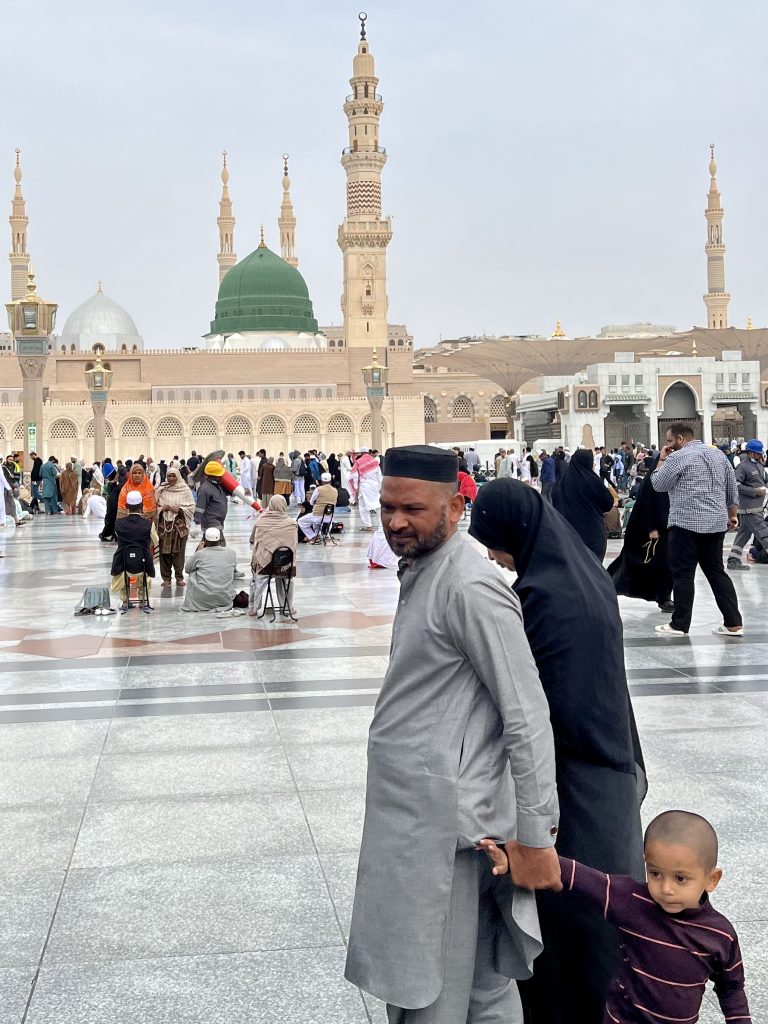
The prophet Mohammed’s tomb at Medina
Another 400 miles carried us to where the desert meets the sea. Jeddah — Saudi Arabia’s historic port — dazzled like a modern jewel. Towering malls shimmered beneath an uncompromising sun; showrooms displayed Porsches and Rolls-Royces as casually as fruit in a market. The thrum of commerce signalled a metropolis looking firmly ahead.
Yet that was not the whole story.
For in Jeddah — unusually for the region — the old town of Al-Balad has been restored and protected. Here, narrow lanes weave between Ottoman-era houses whose wooden mashrabiya windows glow like lanterns at dusk. The souks brimmed with the perfume of frankincense and cardamom; stalls offered Saudi souvenirs and prayer beads, the latest laptops — and of course a fake Rolex or two.
Outside the pilgrimages to Mecca and Medina, Saudi Arabia remained closed to casual visitors until 2019, its doors held shut by custom, law and reputation.
And even now as this desert land opens up, stark social rules, rigid dress codes for women, the shadow of public executions, and the alleged state-sponsored murder of journalist Jamal Khashoggi ensure the kingdom remains, for many, a pariah state.
So what kind of tourist is Saudi Arabia hoping to attract?
Government guides I met declined to specify an age or demographic, but one put it succinctly:
“We welcome anyone interested in our historic past — but there are red lines. Women must dress modestly. And if you are coming here hoping to use alcohol or drugs, please stay at home.”
What stays with me from Saudi Arabia is not merely its scale — vast deserts, megacities, infinite horizons — but its contrasts. A woman’s face resurrected from a rock-cut tomb. A sea of pilgrims swept along by devotion. A port city flaunting its wealth yet cradling its past.
Saudi Arabia is rewriting itself, brick by brick — and story by story.
For the traveller, the journey is not only across geography, but across time itself.
Photos by John Cookson
SAUDI ARABIA — Travel Facts
Visa: E-visa for 60+ countries. VIST HERE
Flights: London to Jeddah/Riyadh return air fares
Budget: £230 – £300. (https://www.wizzair.com/en-gb)
Mid-Range: £300 – £450 with one stop. (Qatar https://www.qatarairways.com Emirates https://www.emirates.com)
Full Service: £500 – £650+ (British Airways www.ba.com Saudia https://www.saudia.com)
Typical hotels per night:
Budget / Economy £20 – £50
Mid-Range (3★–4★) £50 – £130
Luxury (4★–5★) £130 – £300
KEY TRAVEL COMPANIES
Abercrombie and Kent – https://www.abercrombiekent.com
Crystal Travel – https://www.crystaltravel.co.uk
Best at Travel – https://www.bestattravel.co.uk