This Thursday — 7th May — voters in Kensington and Chelsea go to the polls in the most finely balanced local elections the Royal Borough has seen in a generation.
The Conservatives are fighting to hold on to control, with the Labour Party snapping at their heels, and insurgent forces from Reform UK, the Liberal Democrats and the Green Party threatening to up-end the arithmetic — setting the stage for a contest where small shifts could have big consequences. Here, John Cookson gives an insight into the central issues and the jostling for votes as the desperate grab for power approaches.
Kensington and Chelsea’s famously unshakeable Conservative machine heads into the 2026 local elections with its grip still intact — but under sharper, more complex pressure than at any point in recent memory.
For decades, Kensington and Chelsea has been a byword for Conservative Party dominance. From the riverside wealth of Chelsea to the stucco terraces of South Kensington, Tory councillors have been returned with — as some might argue —tedious regularity.
This time, however, the Town Hall’s surface calm masks a more unsettled electorate.

On the ground, voters are less tribal than they once were. Doorstep conversations revolve not around party loyalty but around a knot of local concerns: rising council tax, crime and anti-social behaviour, controversial planning decisions, and the sheer cost of living in one of London’s most expensive boroughs.
Recent fiscal decisions — including council tax rises and the introduction of a premium on second homes — have sharpened that mood. Set against warnings from the Town Hall of a funding gap of over a hundred million pounds, the political weather feels notably chillier for incumbents.
Planning battles have added to the sense of unease. From Earl’s Court to high-profile riverside, disputes over scale, density and character have mobilised residents in ways that cut across traditional party lines. The result is a council increasingly required to defend its record, rather than rely on habit and loyalty.
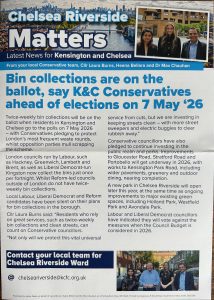
Into that atmosphere steps Reform UK — a party unlikely to win seats outright, but one that could prove disproportionately influential.
Reform’s appeal in RBKC is narrow but potentially potent. It is targeting disaffected Conservative voters — often older homeowners uneasy about taxation, national policy direction, and perceptions of declining local standards.
In a borough where elections are frequently decided by relatively small margins within multi-member wards, even a modest Reform vote share of 5–10 per cent could alter outcomes.
In wards such as Chelsea Riverside and Brompton and Hans Town, that matters. Reform’s presence introduces a new variable into what might otherwise have been predictable Conservative holds. The party’s role is less about victory than disruption — particularly of the Conservative vote.
If Reform complicates the right, the centre-left presents a different kind of challenge.

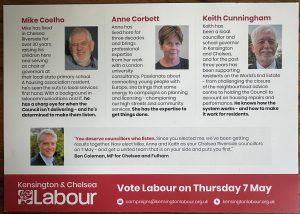
The Labour Party enters the contest with its strongest position in decades. Long dominant in North Kensington, Labour is now within credible reach of broader borough influence, driven in part by the lasting political consequences of the Grenfell Tower fire. That event continues to shape trust, turnout and political identity, particularly in northern wards.
Labour’s strategy is straightforward but difficult: extend its base southwards into traditionally Conservative territory. Its messaging on housing affordability, inequality and public services is designed to resonate in mixed wards where wealth and deprivation sit side by side.
There are signs of traction. Cost of living pressures and dissatisfaction with long-term Conservative control have created openings. But these are not yet decisive shifts. In many southern wards, Labour still faces deeply embedded Conservative networks and voters cautious about a change in control.
Complicating Labour’s advance is fragmentation within the broader progressive vote.
The Green Party is more visible than in previous cycles, particularly in North Kensington. Their pitch — centred on housing, transparency and climate — has found an audience among younger voters and renters. However, the structural realities of RBKC elections present a steep challenge.
In Labour-dominated wards, the Greens, like Reform, risk splitting the vote rather than converting support into seats. Under the borough’s electoral system, even a respectable vote share in the high single digits or low teens may yield no representation. Their influence is therefore likely to be indirect — shaping margins rather than outcomes.
A similar dynamic applies, albeit differently, to the Liberal Democrats.
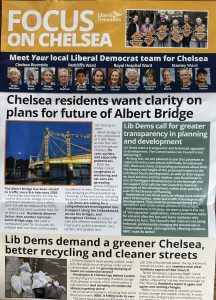
The Liberal Democrats remain the most plausible third force in RBKC politics, with a longer-standing local presence in Earl’s Court and a clearer tactical voting appeal. In more affluent, liberal-leaning wards such as Campden and Pembridge, they offer an alternative for voters uneasy with both Conservative incumbency and Labour’s platform.
Yet they too face a squeeze. In the north, Labour dominance leaves little room for expansion. In the south, anti-Conservative voters increasingly coalesce around whichever party appears best placed to challenge — often Labour in a high-stakes contest. The Lib Dem challenge, therefore, depends on highly localised strength and disciplined campaigning.
The emerging electoral map is one of fragmentation layered over an enduring Conservative advantage.
Key battlegrounds are beginning to take shape. Campden stands out as a ward where demographic change and planning disputes have introduced volatility. Parts of Chelsea Riverside and Royal Hospital could also tighten, particularly if turnout patterns shift or protest voting increases.
Even so, the structural advantages for the Conservatives remain significant. Incumbency, name recognition, and an experienced local machine continue to favour the party. In a borough where turnout tends to skew towards older, property-owning voters, those factors carry weight.
The question is not simply whether the Conservatives retain control, but on what terms.
A strong showing would reinforce their long-standing dominance. More modest results — losses offset by narrow holds — would point to a council increasingly balanced on a knife edge. A more adverse outcome, driven by vote-splitting on the right and incremental Labour gains, could open the door to a shift in control.
What is clear is that the political environment has become more fluid.
No political earthquake is forecast. The Conservative Party remain favourites, anchored by geography, organisation and history.
But in council corridors and on quiet residential streets alike, there is a growing sense that the borough’s blue wall — once taken for granted — is under strain. Not collapsing, but no longer entirely secure.
And as dawn breaks over Hornton Street on Friday May 8th the Conservatives will still be in front
The question now is by how much — and at what cost?