As voters prepare to go to the polls, The Chelsea Citizen’s JOHN COOKSON cuts through the campaign noise (and all those annoying, highly shreddable letterbox leaflets) to pose FIVE sharp, no-nonsense questions to representatives from the five main parties seeking power in Kensington and Chelsea. We cover bread and butter issues such as tax, crime, planning, housing, and the day-to-day realities facing residents across the Royal Borough. Hopefully, these answers can help guide your hand when it comes to marking what will be some of the most congested ballot cards in recent voting history.
Conservative Leader Cllr Elizabeth Campbell
QUESTION 1: The Conservatives have run RBKC for decades — why should voters trust you to fix problems like rising costs, crime and planning rows that have all worsened on your watch?
“I am proud of our record over the last ten years. Whilst councils across London have gone bankrupt, raised council tax by double digits, or cut bin collections to just once every three weeks, we have kept council tax rises to the minimum, protected all the services our residents really care about like twice weekly bin collections, whole borough parking permits and outstanding parks. Our approach has delivered £22 million in savings this year alone, without any impact on services. It’s because of our focus on efficiency and productivity that we were recently awarded the most productive council in the country.
And let’s be clear about the backdrop we are operating in. A Labour Government whose policies have uniquely punished this borough, whether that’s £108 in Fairer Funding, mansion tax, non-doms and higher National Insurance rates and a Labour Mayor who has completely failed to tackle crime.
Labour is wrecking this country and wrecking London. It is clear that they don’t care about the residents of Kensington and Chelsea. I do, and here in the blue island we are delivering for our residents.”
QUESTION 2: Council tax is up again — can you guarantee no further rises, and if not, what exactly will residents be asked to pay?
“Kensington and Chelsea has the fifth lowest Council Tax in Britain. And in the first year of this term (2022/23), we froze Council Tax amid the cost of living crisis and 10 per cent inflation. Value for money is in our DNA and I have always believed that your money is best kept in your pockets
But it is getting harder to manage budgets: the Labour Government’s vindicative and punishing “fair funding” review has left us with a gap of £108mn over the next four years.
Any party that says they can close this gap whilst freezing or cutting tax is not being straight with voters – and would soon find themselves with little choice but to make swingeing cuts to core services, like our twice weekly bin collections.
£108mn savings in four years means this is no time for novices on Hornton Street.
Last year, we made £22mn of savings: more than 100 staff left the organisation, some capital projects were paused or shelved, and fewer agency staff are on the books. We will continue this work to bear down on pressures. We will always seek to minimise costs to residents, and we have a team with the experience to do this.
We are putting together a clear and comprehensive plan for the years ahead to deliver the savings we need, all whilst protecting the services our residents really care about.”
QUESTION 3: On planning, critics say the borough lurches between overdevelopment and blocking schemes — what is your clear, consistent policy going forward?
“Our policy has always been clear, we welcome well designed mixed developments which provide much needed housing in this borough. You’ve seen this in our approach to major sites in the borough like Earl’s Court, and indeed South Kensington where our campaign has led to TFL finally agreeing to provide full step-free access.”
QUESTION 4: Whilst residents appreciate twice weekly bin collections they complain about slipping day-to-day services — from street cleaning to enforcement — how will you put it right?
“We are the only place in London that collects the bins twice weekly – and we have some of the capital’s cleanest streets.
We are also investing in our public realm like never before. In Chelsea, in the last four years we have delivered new spaces at Chelsea Green and Sloane Street, brought the Oscar Wilde statue to Dovehouse Green, and worked with residents on improvements to Chelsea Embankment. We are also bringing the first new park to the borough in decades at Lots Road, alongside a new river walk and pier.
Moreover, we have a fully costed plan which we are implementing now to increase street cleaning from electric waste buggies borough wide, additional street sweepers and more frequent jet washing of pavements.
We have introduced a street enforcement team – there is a named officer tackling anti social behaviour in all our wards. This team has issued more than 8,000 FPNs in the past 12 months, cracking down on fly tipping, graffiti and more.
We have also seized more than 2,000 e-bikes left on streets and fined the operators (no other London borough is doing this).
If elected, we will pilot a new nighttime enforcement team to tackle anti-social behaviour later in the evenings.”
QUESTION 5: With a large funding gap and growing pressure on services, where will the cuts fall — and what won’t you guarantee?
“The Labour Government’s “fair funding” review has left us with a gap of £108mn over the next four years.
Last year, we made £22mn of savings: more than 100 staff left the organisation, some capital projects were paused or shelved, and fewer agency staff are on the books. We will continue this work to bear down on pressures. We will always seek to minimise costs to residents, and we have a team with the experience to protect core services, such as the bin collections and boroughwide parking.”
Labour Councillor Kasim Ali
QUESTION 1: You want to run the council — what would you do differently in your first 100 days that residents would actually notice?
“Fixing years of poor management will take time, but residents would see a clear change quickly. We would start with the basics: cleaner, safer streets. That means on-the-spot fines for dockless e-bikes blocking pavements, tougher enforcement on dog fouling, littering and fly-tipping, and proper action where residents report persistent problems.
We would restore full council tax support for the poorest 5,000 families. The current cut saves the council very little, but it matters enormously to the people affected.
We would put RBKC’s housing department into special measures. The department has already been given the second lowest rating by the housing regulator, and they have the third highest complaints of any local authority in the country.
We’d ask the Government to step in, audit RBKC’s housing team, culture and processes, and create a plan for improvement.
We would expand school streets where communities want them, using camera enforcement so children can get to school safely without creating a large new cost.
And we would change how the council listens. Too often residents are treated as a problem to be managed rather than people who know their own streets, estates and neighbourhoods.
We would also protect the services residents rely on, including twice-weekly bin collections and borough-wide parking.”
QUESTION 2: Council tax keeps rising while many feel services are slipping — how would you improve delivery without asking residents to pay more?
“The council does not have a money problem so much as a management problem.
Major projects have run badly over budget, including Lancaster West and Pembroke Road Waste Depot.
The council also spends large sums on external consultants while core services still struggle.
They don’t even follow their own advice. Months before the cyber attack that crippled services and lost personal data, RBKC carried out an audit of their cyber security that found significant flaws. They then failed to implement their own recommendations – and the cyber attack was the inevitable result.
We would get a grip on that. Better project control, less reliance on consultants, and stronger in-house capacity would save money and improve delivery.
We would also charge the full council tax premium on second homes, as other London councils do. That is a fairer way to raise revenue than asking ordinary residents to pay more.
We would protect everyday services, keep council tax low, and stop wasting money through poor management.”
QUESTION 3: Housing is the borough’s fault line — can you guarantee genuinely affordable homes for local people, not just headline numbers?
“No council in London can honestly guarantee that every local person who needs a genuinely affordable home will get one quickly. The housing crisis is too deep for that.
But the current council is not doing enough with the powers and homes it already has.
Labour would stop selling off council properties, improve the homes already in council ownership, and put the failing housing department into special measures.
Too often repairs are delayed until the problem becomes worse and more expensive.
We would also hold housing associations and private landlords to account, regulate short-term lets, and support better standards in the private rented sector.
New homes matter, but so does protecting the homes we already have.
Affordability cannot just be a number in a press release. It has to mean homes local people can actually live in.”
QUESTION 4: Crime and anti-social behaviour are constant doorstep issues — what practical, borough-level actions would you take beyond calling for more policing?
“The council needs to stop assuming it always knows best.
On many estates, residents already know what would make them safer: working security doors, better lighting, proper waste storage, more CCTV, or action on a specific hotspot. The council’s job is to listen, fund the practical fixes, and make sure they are maintained.
St Joseph’s Close is a good example. Residents wanted a security gate and better waste storage to deal with fly-tipping and anti-social behaviour. Labour councillors and our MP backed them, and the situation improved.
We would hire council anti-social behaviour wardens, expand CCTV where residents want it, fund youth engagement work, and act properly on speeding, fly-tipping and street crime hotspots.
This is about practical local action, driven by residents.”
QUESTION 5: RBKC is one of the most unequal boroughs in Britain — what is your concrete plan to close the gap between North Kensington and the south, and how quickly would people see results?
“The gap between north and south Kensington is stark. It shows up in life expectancy, child poverty, health, housing, income and access to services.
Our plan is to put council resources where need is greatest.
We would restore council tax support for the poorest families, invest in local voluntary and community organisations, protect advice services and libraries, improve unsafe and unhealthy homes, and support families with SEND, school attendance, uniforms and childcare.
We’d also invest in North Kensington’s infrastructure, including securing funding for step-free access at Ladbroke Grove station and improving public transport links.
Some changes would be felt quickly, especially council tax support, cleaner streets and better enforcement. Others, like health, housing and transport, take longer. But the test is whether council decisions consistently narrow the gap rather than deepen it. Right now, they too often do the opposite.”
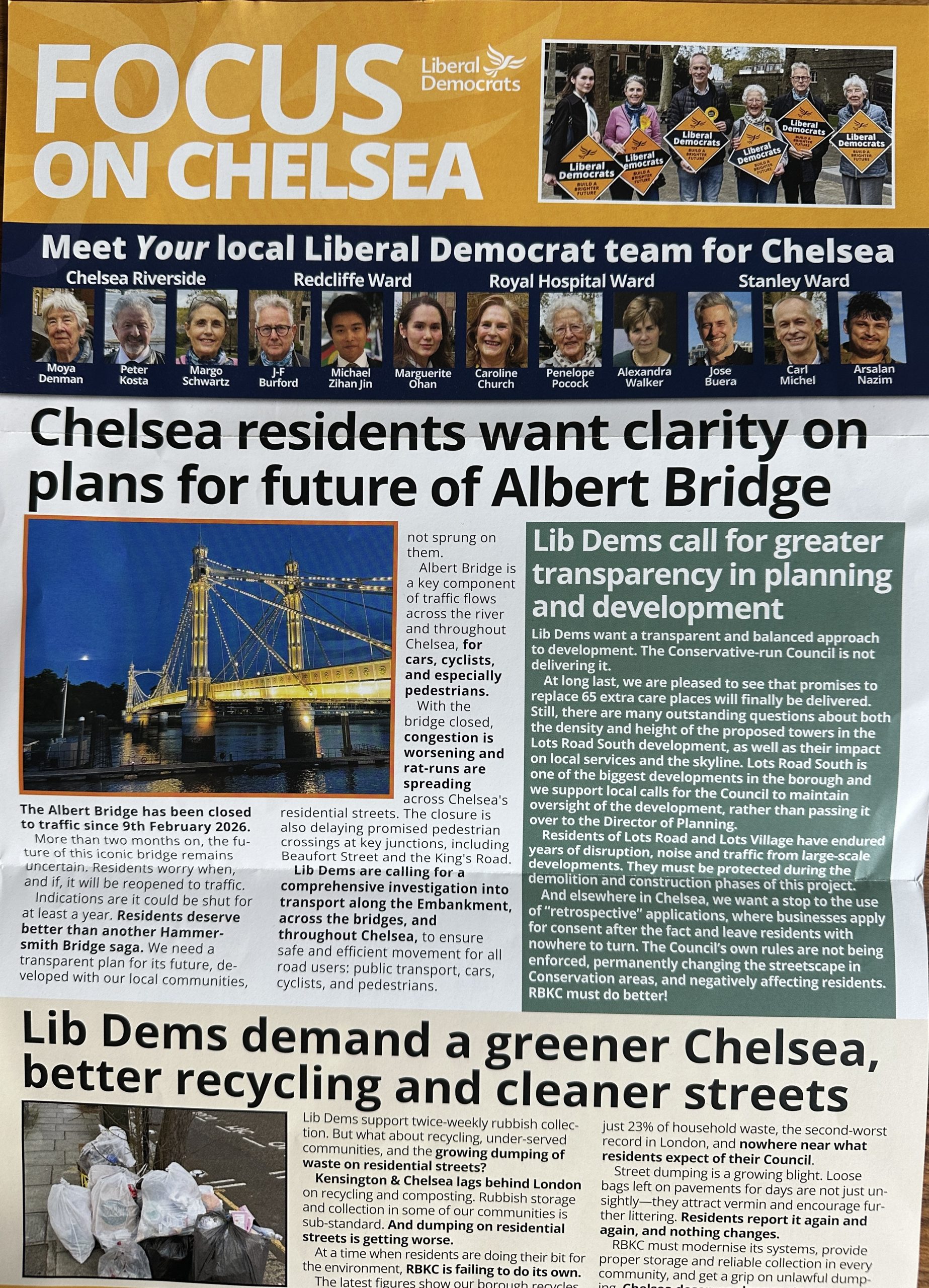
Liberal Democrat Party’s Margo Schwartz (running for Riverside)
QUESTION 1: You talk about holding the council to account — but what specific decisions would you reverse or try to change if elected?
“We are campaigning for a safer, greener and fairer borough. We will work hard all year and listen to our residents.
We are calling for a comprehensive review of traffic patterns in Chelsea and throughout the borough. With the Albert Bridge closed, this can no longer be delayed. Pollution, rat-running, the lack of sustainable transport, alongside unsafe junctions, and the lack of cycling infrastructure pose real problems in RBKC. The Council needs to fight to protect further cuts to public transport; and make our roads safer for all users.
We will support local businesses and bring empty homes back into use, and act on long-term vacant properties. And we will demand a short-term lettings register so the Council knows where these properties are and can protect the availability of long-term homes for local residents.”
QUESTION 2: Council tax is rising while services feel stretched — how would you balance the books without hitting residents with further increases?
“We need to think about new sources of income for the council.
We have reviewed the budget and because of the lack of detail on the contracts, the services and the cost of the existing council infrastructure it’s difficult to comment on the budget on a granular level.
That being said, new sources of income could include:
1. Establishing a register for all short term lets across the Borough. This would make enforcement of breach of rules easier thereby reviving income through fines. The council already has infrastructure to monitor licensing for HOAs so we could piggy back off that. This would also mean that those short term lets that breach the 90 day rule would need to pay rates for running a business.
2. Enforcement of speed limits, by placing speed camera that automatically enforces tickets we can reduce speeding and rat-running while increasing fees.
3. Annual pavement licences for Business (rather than every two years).
4. Enforcement of fines on e-bikes.
If we focus on enforcement of existing rules we can prioritise on-going nuisances for residents while getting more income into the council.”
QUESTION 3: Planning battles are everywhere in RBKC — from overdevelopment to stalled sites — where do you stand on protecting neighbourhood character versus building new homes?
“We have long championed transparent and balanced planning, and opposed over-development in RBKC. Our councillor, Linda Wade in Earl’s Court, has been at the forefront of the fight to make the redevelopment of the Earl’s Court site a sustainable project.
It is important that large-scale developments take local concerns into account, and that these projects actually result in the provision of homes for local residents at all levels including social, affordable and market rents. We also want these developments to be livable with green spaces, adequate infrastructure – from updated sewers to parks, to GP practices, to shops, etc.
And the planning process needs to be transparent. The Council needs to work with local communities and listen to their concerns. Here in Chelsea, we have waited many years for the replacement of the 65 extra care beds, but the full extent of the impact of the Lots Road South development on Lots Village remains unclear.
We support local calls for Council to maintain oversight on this project, and not just pass responsibility on to the Planning Directorate. And, the building phase has huge consequences for local residents in terms of noise and dust and congestion. Demolition and construction traffic and management plans need to be robust and they need to be enforced.
We are also worried about other planning issues. The rush to push delayed planning applications through, following on from the cyber attack, means that local residents are not able to comment, and bad decisions could result.”
Increasingly, we are seeing developments in Conservation Areas that are changing the very character and streetscape of our traditional areas in Chelsea.
We are also very worried about the use of “retrospective” applications by local businesses to circumvent residents’ concerns, and the Council’s own rules.”
QUESTION 4: Crime and anti-social behaviour are a growing concern on the doorstep — what practical steps would you take locally, beyond calling for more police?
” We are calling for dedicated police hubs across the borough, greater communication with residents, as well as more police on the streets. In Chelsea, residents can get updates from the police, but petty crime is still rising and some areas of Chelsea have experienced more serious crime. Having more police to tackle some of these issues, as well as designated police hubs, would no doubt go some way to curbing crime and making residents feel safer.
In addition, we will work to identify and tackle anti-social behaviour hotspots. We will strenuously oppose planning and licensing applications of businesses that do not contribute positively to our high streets, and which attract anti-social behaviour.”
QUESTION 5: The borough is deeply unequal — from North Kensington to Chelsea — what is your concrete plan to narrow that gap?
“There are significant inequalities in RBKC, with a shocking differential with regard to life expectancy and good health – 18 years for women – between the north and south of the borough. This was most clearly illustrated by the horrific loss of life in the Grenfell Tower fire. And, here in Chelsea, we are a diverse community with many residents living in homes that contribute negatively to their health too. We know that poor housing is a major contributor to the inequalities in this borough. Tenants should not be living in mould-ridden flats, or have inadequate space in which to dispose of rubbish leading to unsightly properties and the increase in vermin. Imagine being in a flat on the 7th floor with no working lift, locked in your room? Or at World’s End, many floors higher up.
Other contributors are pollution, an inadequate provision of mental health support, early childhood intervention, and youth programming, to name but a few indicators. RBKC can and must do better.”
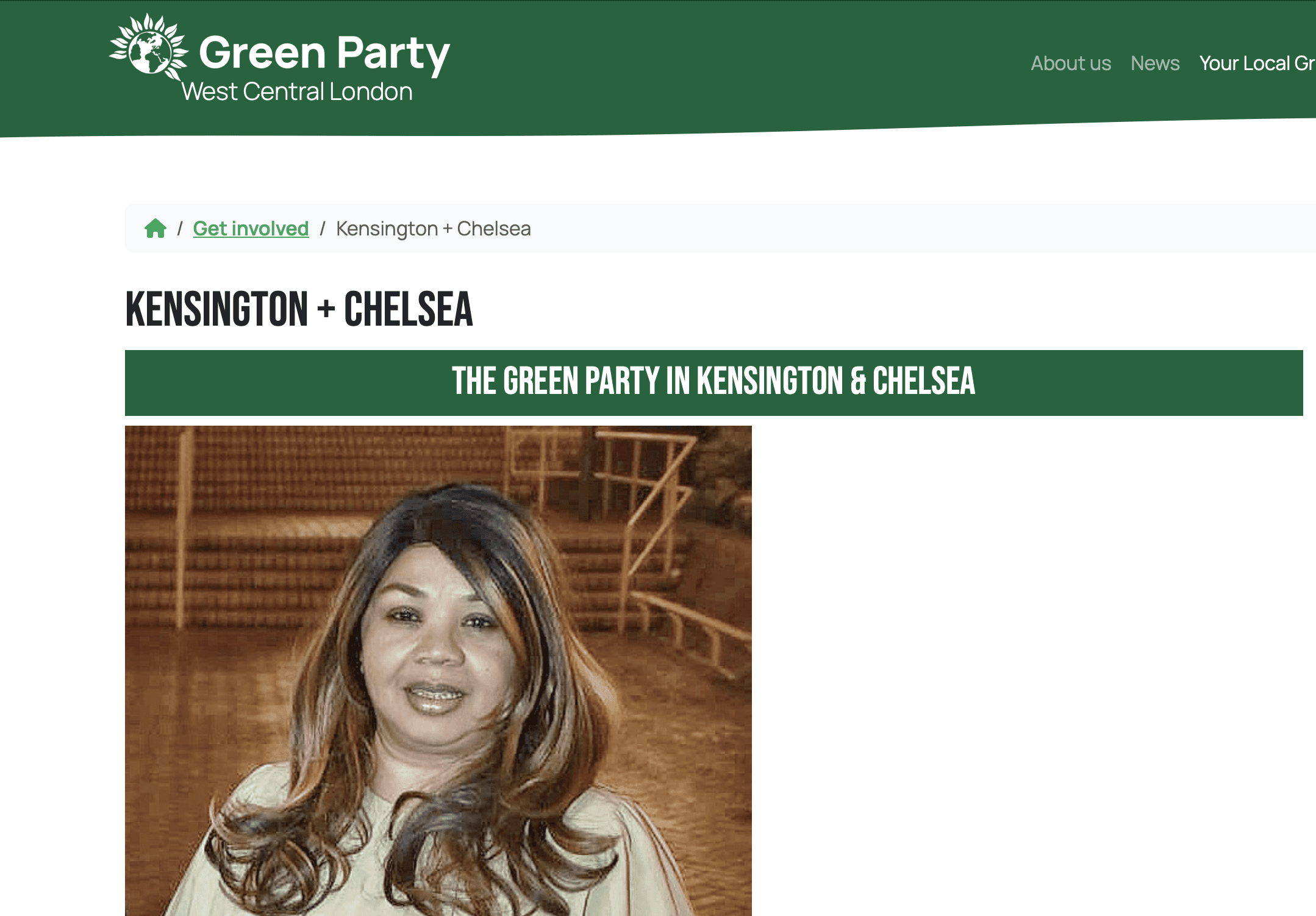
The Green Party’s Councillor Mona Adam
QUESTION 1: You campaign hard on climate , but what specific local policies would residents actually notice changing in their daily lives within a year?
“Our small businesses need help to reduce their climate impact and, at the same time, save money on long-term energy bills. Within a year, we would like to see a sustainability network similar to those in Camden and Islington.
K&C is behind the curve when it comes to making our food system more sustainable.
Other London boroughs have developed partnerships to make affordable food available that helps, rather than damages, the climate and the environment.
Our food sector can be brought together to create an action plan within a year.
The biggest impact on residents will come from helping people insulate their homes and adopt clean heating technology like heat pumps.
But this needs government funding, and a strong showing for the Greens will help put pressure on the government to deliver on this.”
QUESTION 2: Many voters worry green policies mean higher costs — how would you push environmental measures without making living in RBKC even more expensive?
“The affordability crisis is being driven by war and instability pushing up the cost of fossil fuels.
UK-produced clean solar and wind energy will make our energy system cheaper and more secure.
Making public transport more affordable and improving home insulation are both climate-friendly and reduce costs for residents.
Some of the opportunities to bring in clean technology to our services could actually provide a secure income for small investors.
Many councils have promoted Green Bonds with a minimum investment as low as £5, and we could do the same.
We have areas of poverty, but also some of the highest concentrations of wealth in the UK.
It’s time we tapped this local wealth to benefit us all.”
QUESTION 3: On planning, would you prioritise new housing or protecting existing neighbourhood character when the two come into conflict?
“We can have both with well-designed, mid-density homes, but this must be council-led.
As long as housing development is led by developers and landowners, those who need a home but can’t afford one will get the worst deal, whether in character or location.”
QUESTION 4: Traffic, congestion and air quality are constant complaints. What concrete changes would you make to roads and transport that wouldn’t simply shift the problem elsewhere?
‘Traffic management, safer walking and cycling, and constant improvements to public transport have been proved to improve air quality.
The data shows that stopping rat-running through neighbourhoods doesn’t simply “shift the problem” it genuinely reduces it, as people make different choices about their transport.”
QUESTION 5: In a borough where you’re unlikely to control it, how would you realistically turn influence into results?
“Greens have a track record of making constructive suggestions whoever is in power, both in public forums like council meetings, and behind the scenes by sharing great examples with staff or councillors from other parties.
We also champion community groups who can themselves push the council to do better.
We will use every tool in the toolkit to encourage the council to do better.
We don’t just oppose for the sake of it.”