In the Royal Borough’s corridors of power, council chiefs have donned their tin hats as they face up to explaining the consequences of a £108 million black hole that will devastate the Borough’s finances.
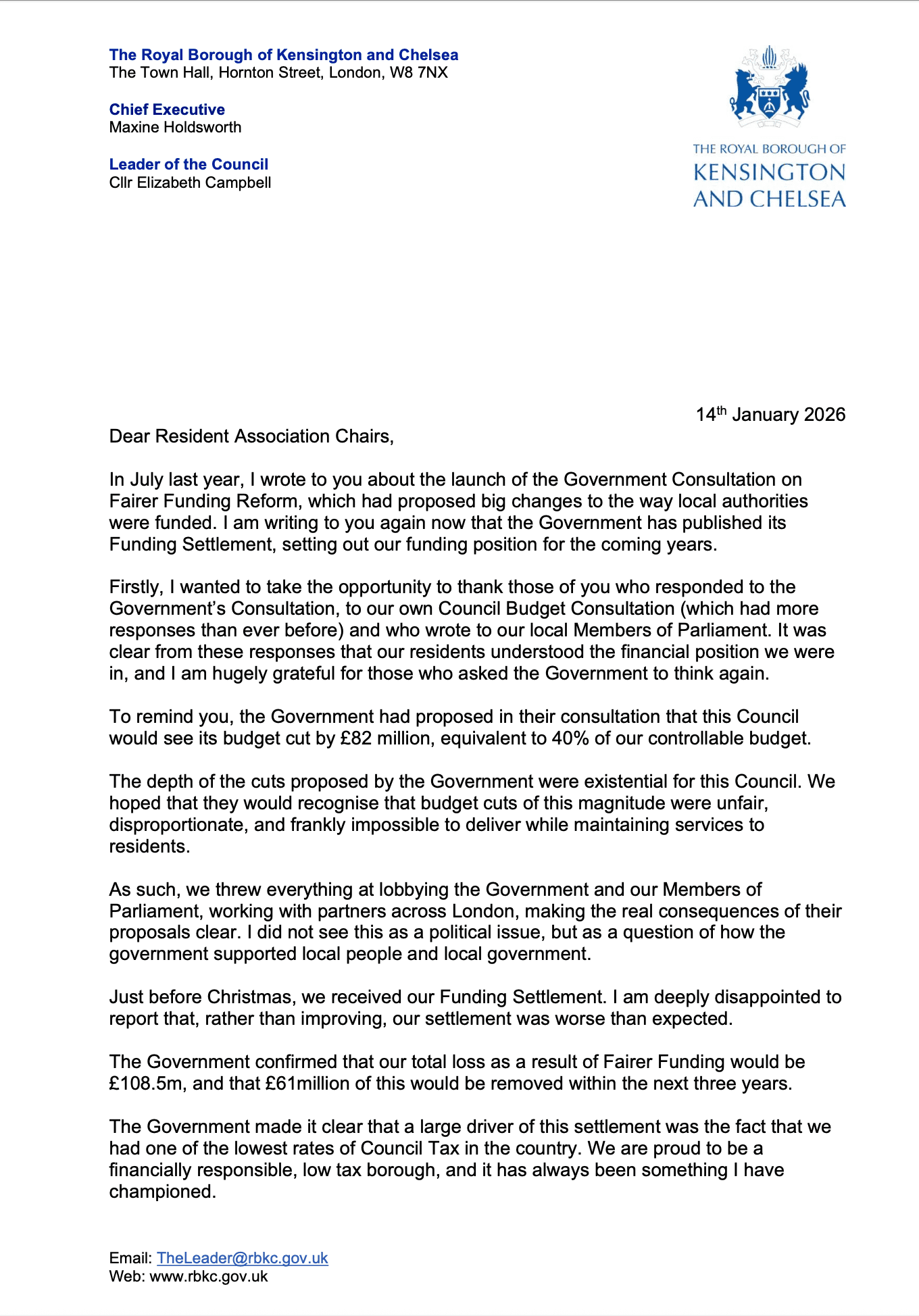
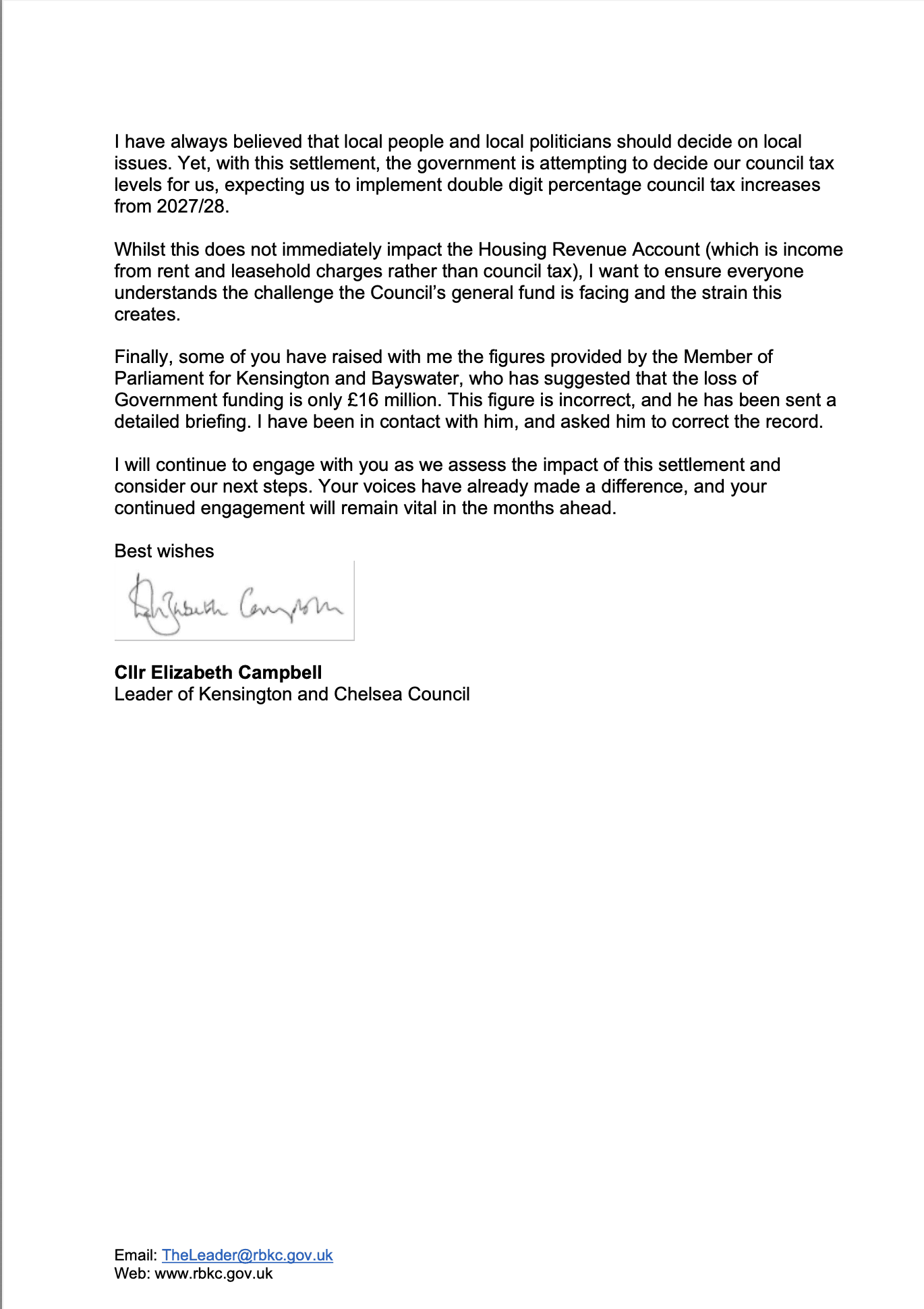
In a letter to residents’ associations this week, Tory Council Leader Cllr. Elizabeth Campbell warned that central government’s so-called ‘Fairer Funding’ reforms will seriously impair RBKC’s future spending powers.
In the past, Cllr Campbell has insisted that vital frontline services are ring-fenced, but the brutal truth is this: something has to give. So, The Citizen has been investigating where the axe will fall.
Residents? Council workers? Pensioners on fixed incomes? Vulnerable families? Tenants already staring at yet another bill? The answer is uncomfortable: All of the above.
But first — a sliver of good news amid the gloom. Residents have been braced for the possibility of a double-digit council tax hike. We can reveal that the imminent rise in council tax for 2026-27 will be “only” 5%. It is next year that a double digit increase could be levied, to come into effect for 2027-28.
Central government has indicated to RBKC that it could need to raise the tax by 17% to manage the financial short fall. RBKC chiefs say that they are hoping to avoid such drastic action by findings savings across the board in the coming year.
Relief, then — but only up to a point. Because the £108 million still has to be found somewhere. In peril is the Council Tax Reduction Scheme — the safety net that helps low-income households pay their council tax. RBKC currently supports thousands of working-age residents through the scheme.
But under pressure to balance the books, the Council has been looking at reducing that support — meaning some people who currently pay little could soon be forced to pay more. And the 5,000 who receive a “100% reduction” and pay nothing will have to find some cash from somewhere.
In other words: the Borough may end up plugging its financial hole by asking those with the least to shoulder some of the load.
Then there’s the Council’s workforce, which currently stands at around 2,600. A voluntary redundancy programme – entitled ‘Business Efficiency and Voluntary Redundancy Scheme’ – has been in place since March last year. So far, 109 staffers have left and RBKC hopes to save £4.4m in annual salaries once the scheme is completed.
Translation? A slow tightening of the screw, with fewer staff doing more work, and more residents pushed towards online systems whether they like it or not. There is a plan in motion to use AI tools more extensively in council services. Meanwhile there are other revenue-raisers on the table.
RBKC has one of London’s highest concentrations of second homes, so there are clear intentions to double the council tax charge on second homes, a levy many other authorities have already adopted. Plus, there are ideas afoot to exploit heritage assets in the borough in advertising partnerships in a similar way to how Cadogan Estates “sold” Sloane Square to fashion giant Ralph Lauren to turn it into a Christmas marketing venue. (The King’s Road in partnership with Cartier”, anyone?!)
Parking charges are also likely to creep up. The Council issues thousands of parking permits a year, and while any rise may be modest, it all adds to the sense of a borough quietly squeezing residents wherever it can. And what about the sacred cows?
The Tory-led council is fiercely proud — and, arguably, rightly so — of its twice-weekly bin collections. The Citizen has been assured that these will stay, so don’t expect your rubbish to start piling up just yet. But even if the bin collectors keep coming, the warning signs are everywhere.
Because while Westminster sells Fairer Funding as a tidy reform — a way of making local government finance “fairer” across the country — in cash-strapped Kensington and Chelsea, already dealing with a hammer blow cyber attack, it feels like something else entirely.
The Borough is being told it must do more, with less. And here’s the sting in the tail. When central government changes the rules, it isn’t Whitehall that feels the pain.
It’s the single parent quietly opening a revised council tax bill.
It’s the Council worker who finds their job done by AI.
It’s the pensioner who can’t navigate an online-only system.
And it’s the Kensington and Chelsea residents’ groups and local charities — the ones who patch up the cracks before they become chasms — who suddenly find the funding has “been reviewed”.
RBKC Leader Cllr Elizabeth Campbell’s letter that went out this week to 275 Residents Associations and 600 voluntary groups